The Neurodivergent Triad and the Hardware of Neurodivergence: Connective Tissue, Autonomics, and the Body-Brain Connection
Neurodivergence is frequently framed exclusively as a difference in brain wiring—a divergence in how information, sensory input, and social cues are processed. However, for a significant portion of the neurodivergent population, the differences extend far below the neck. Autism and ADHD are highly correlated with a specific cluster of systemic physical health conditions, often referred to as the “Neurodivergent Triad”: the overlapping presentation of neurodivergence, connective tissue differences, and autonomic or immune dysregulation.
When the physical “hardware” of the body operates differently, it fundamentally alters the data sent to the neurological “software.” Understanding this interaction is critical, as many emotional and cognitive challenges are actually rooted in unrecognised physical distress.
1. The Genetic Foundation: Collagen, Connective Tissue, and the RCCX Theory
The physical manifestations of neurodivergence frequently begin with genetics, specifically the genes responsible for producing the body’s extracellular matrix (ECM). The ECM is the structural scaffolding of the body, primarily composed of collagen, which accounts for roughly 30% of all human protein. It forms ligaments, tendons, the vascular bed (blood vessels), skin, and the lining of the gastrointestinal tract.
-
Hypermobility Spectrum Disorders (HSD) and EDS: Emerging clinical research has demonstrated a statistically profound overlap between neurodivergence and connective tissue conditions like Ehlers-Danlos Syndrome (EDS) and HSD. In these conditions, genetic variations alter the synthesis of collagen or associated glycoproteins, rendering the connective tissues abnormally lax, elastic, and fragile.
-
The RCCX Gene Module Theory: To understand why neurodivergence, hypermobility, and immune issues cluster together, researchers often point to the RCCX gene module on chromosome 6. This specific genetic region is highly prone to mutation and duplication, and it houses three critical genes in close proximity:
-
CYP21A2: Regulates the cortisol stress response.
-
TNXB (Tenascin-X): Crucial for connective tissue elasticity and integrity.
-
C4: A protein integral to the immune system and synaptic pruning in the developing brain (a key factor in neurodivergent neurology).
Because these genes sit adjacent to one another, a genetic variation in this region can be inherited as a single package, explaining how a person can simultaneously inherit an altered neurological processing style, fragile connective tissue, and a reactive immune system. -
2. Physical Functioning: Proprioception, Interoception, and Sensory Integration
When the body’s physical scaffolding is highly elastic, it profoundly disrupts the sensory data traveling up the spinal cord to the brain via the peripheral nervous system. This mechanical difference directly impairs how an individual navigates the physical world and processes their own internal needs.
-
Proprioception and Mechanoreceptors (The External Map): Proprioception relies on mechanoreceptors embedded within the fascia, ligaments, and tendons. These receptors detect stretch and tension, sending continuous signals to the brain to report where the body is in three-dimensional space. When connective tissue is excessively lax, these receptors do not stretch normally, sending “noisy” or weak signals. The brain is left without a clear physical map, which can lead to dyspraxia, clumsiness, or an uncoordinated gait.
-
The Metabolic Cost of Muscle Hypertonia: Because elastic ligaments cannot hold the skeleton together passively, the brain compensates by commanding the muscles to remain in a state of chronic, active tension (hypertonia) to artificially stabilise the joints. This means simply sitting upright requires continuous isometric muscle contraction, triggering myofascial pain, micro-tears, and profound baseline fatigue.
-
Interoception and the Anterior Insula (The Internal Map): As explored in our discussion on interoception and the emotional life of neurodivergent individuals, sensing internal states (like hunger or bladder fullness) is highly complex for the neurodivergent brain. Because lax connective tissue and dysautonomia send chaotic, fluctuating signals, the brain experiences chronic interoceptive prediction error. It becomes overwhelmed by the noisy data and begins to tune it out. As a result, an individual may not register a gradually filling bladder until it is a painful emergency, or they may fail to notice hunger until it manifests as severe hypoglycemia and a systemic meltdown.
3. Autonomic and Immune Dysregulation (POTS, MCAS, and the Gut-Brain Axis)
The autonomic nervous system regulates automatic bodily functions like heart rate, blood pressure, and digestion. In the neurodivergent triad, this system is frequently destabilised by the underlying connective tissue differences and chronic neuro-immune cross-talk.
-
POTS and Cardiovascular Hemodynamics: Postural Orthostatic Tachycardia Syndrome (POTS) is fundamentally a disorder of hemodynamics. Because the blood vessels are constructed with excessively elastic collagen, they lack the rigidity needed to constrict efficiently against gravity. When an individual stands up, blood pools in the lower extremities. The sympathetic nervous system overcompensates by dumping norepinephrine (a stress hormone) into the bloodstream to force the vessels closed, driving the heart rate up dramatically. This hyperadrenergic state causes dizziness, cognitive fatigue, and tremors.
-
MCAS (Mast Cell Activation Syndrome) and Neuroinflammation: Mast cells are the sentinels of the immune system, residing at the body’s boundaries (skin, gut, blood-brain barrier) and immediately adjacent to peripheral nerve endings. In MCAS, these cells become hyper-reactive. Upon triggering, they release chemical mediators, including histamine. Crucially, histamine acts as an excitatory neurotransmitter in the central nervous system. This biochemical storm causes acute neuroinflammation, driving the profound “brain fog,” psychomotor agitation, and sudden drops in executive function that neurodivergent patients frequently experience.
-
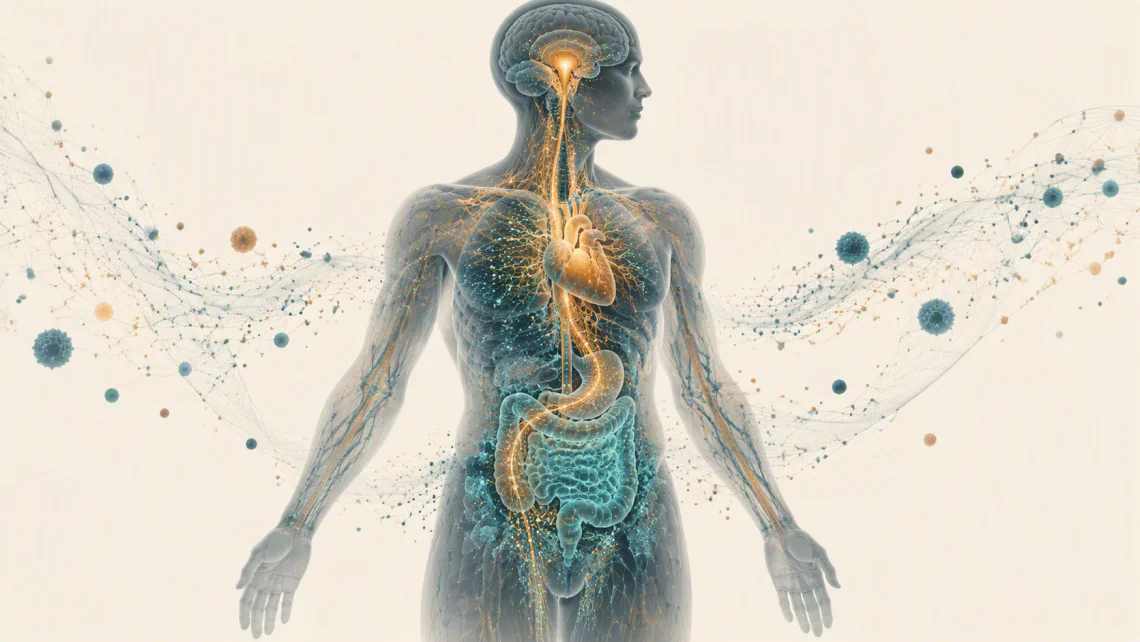
The Vagus Nerve and Gastrointestinal Dysmotility: The gastrointestinal tract relies on connective tissue to execute peristalsis (the movement of food). Laxity here causes delayed gastric emptying or chronic dysbiosis. The gut and the brain are wired together via the vagus nerve. When the gut is inflamed, the vagus nerve transmits a continuous barrage of distress signals directly to the brain’s threat-processing centres. This gut-driven neuroinflammation is a primary biological driver of the psychological distress observed in neurodivergent burnout and allostatic overload.
4. The Interaction with Neurology and Emotional Life
The neurodivergent brain relies heavily on bottom-up processing—meaning it builds its understanding of the world from raw, unfiltered sensory and physical data. When the body’s hardware is struggling with POTS, MCAS, and hypermobility, the brain is flooded with a constant stream of physiological “danger” signals.
-
Physiological Anxiety vs. Psychological Anxiety: When blood pools in the legs and the heart races at 130 beats per minute (POTS), or when a mast cell degranulation dumps histamine into the bloodstream (MCAS), the brain registers a severe emergency. The amygdala activates the fight-or-flight response. The individual feels an intense, overwhelming sense of dread and agitation. This is often misdiagnosed as standard psychiatric anxiety, but it is actually a correct neurological interpretation of a physical cardiovascular or immune crisis.
-
Alexithymia and Emotional Bandwidth: Living with constant joint pain, unrecognised hunger, a racing heart, and a distressed gut consumes massive amounts of prefrontal cognitive energy. With all bandwidth dedicated to managing physiological chaos, there is little energy left for emotional regulation, executive function, or social masking. Furthermore, the chaotic interoceptive signals exacerbate alexithymia; when the body is always in pain or autonomic distress, it becomes nearly impossible to accurately identify and process subtle emotional states like sadness, frustration, or joy.
-
The Cycle of Burnout: This interaction explains why standard psychiatric interventions often fail. You cannot talk a nervous system out of a POTS flare or a hypermobile joint subluxation. If these physical realities are ignored, the neurodivergent individual is left trying to out-think a physiological crisis. This mismatch contributes to allostatic overload, generating shame, and culminating in systemic burnout.
True support must always consider the hardware alongside the software, recognising that validating and treating the physical body is one of the most effective ways to calm the neurodivergent mind.
Neurodivergent Processing, Emotional Regulation, and Integrative Health is a six-part series of posts by Dr Simon van Lieshout that bridges neuroscience, lifestyle medicine, and Anthroposophic health principles. It explores the unique neurological architecture of neurodivergent minds—focusing on bottom-up processing and monotropic attention—and explains how navigating a neuronormative world can lead to sensory fatigue, allostatic overload, and complex functional comorbidities. By moving beyond traditional behavioural models, this series provides a comprehensive, neuro-affirming framework alongside practical, somatic strategies to regulate the nervous system, build processing capacity, and foster deep, integrative healing.