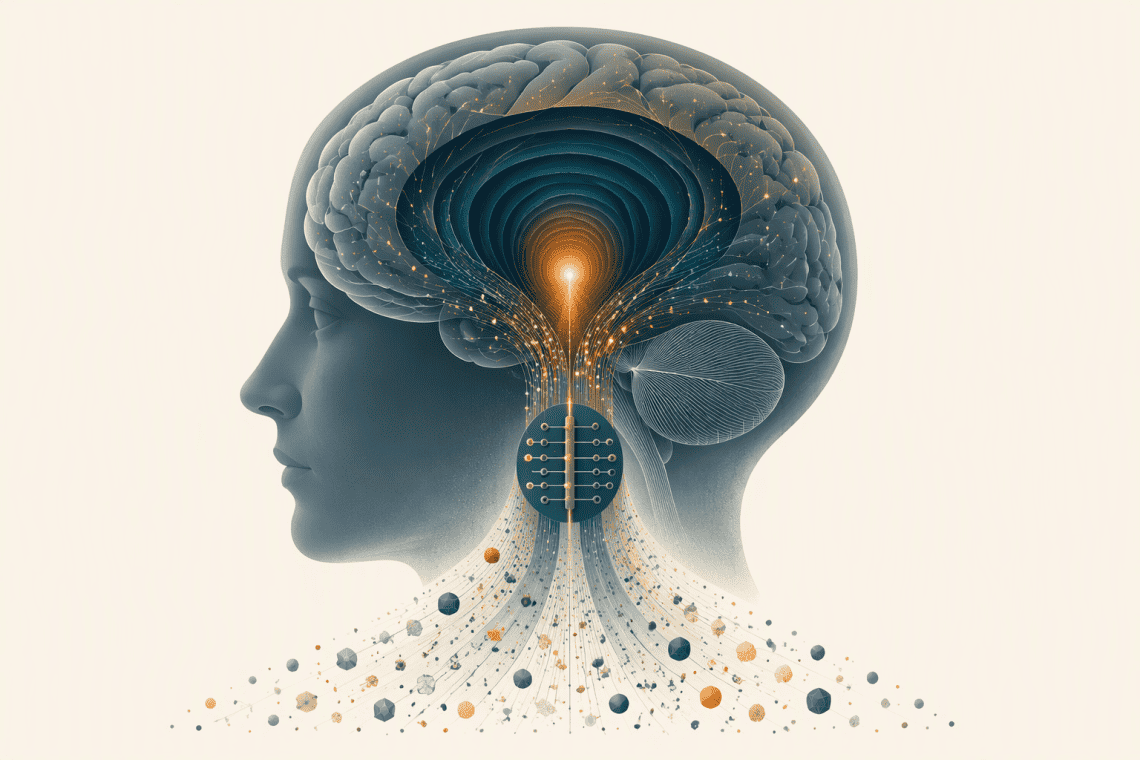
The Neurology of Neurodivergence: Bottom-Up Processing and Attention Tunnels
The neurodivergent brain—encompassing profiles such as Autism, ADHD, AuDHD, Dyspraxia, and Dyslexia—operates with a distinct neurological architecture. Many neurodivergent individuals are highly functional, utilising the unique strengths of this architecture, such as deep focus, rapid pattern recognition, and innovative problem-solving. However, these cognitive differences bring specific tendencies in how information and attention are filtered, requiring active management to maintain balance.
A primary distinction lies in sensory processing. In a neurotypical model, the brain relies heavily on top-down processing and Predictive Coding Theory, utilising prior knowledge to automatically filter out irrelevant sensory data before it reaches conscious awareness. This is often compared to a colander, allowing extraneous sensory input to drain away. Neurodivergent individuals, conversely, lean heavily toward bottom-up processing, functioning more like a bowl. Raw sensory data—fluctuations in lighting, background noises, or the texture of clothing—tends to be absorbed in its entirety. This occurs because sensory gating mechanisms in the thalamus, the brain’s neurological switchboard, are often more permeable, meaning the brain must consciously categorise a much higher volume of information.
This difference in sensory filtering is closely tied to Monotropism, a leading theory regarding neurodivergent attention. While a neurotypical brain is often “polytropic” (able to divide attention across multiple inputs), a neurodivergent brain is frequently “monotropic.” It pulls all processing resources into a singular, intense attention tunnel. This enables profound states of flow and deep work but makes sudden task-switching physically exhausting, as the brain must manually deconstruct one attention tunnel and build another.
Managing this volume of unfiltered data and monotropic shifting places a high metabolic demand on the prefrontal cortex, the region responsible for executive functions like conscious decision-making and emotional control. As the prefrontal cortex expends its energy managing sensory input and attention, its capacity to regulate the brain’s threat-detection centre (the amygdala) is reduced. Without adaptive strategies, this continuous cognitive load increases the tendency for the nervous system to misinterpret dense sensory environments as physical stressors.
Further reading on this topic:
- The Transmitter / Spectrum: An accessible public science article explaining the predictive coding theory of autism and how neurodivergent brains process incoming sensory data differently.
- National Autistic Society (NAS): An authoritative UK resource providing lay-friendly guides on monotropism, explaining the “attention tunnel” concept, flow states, and why task-switching requires heavy cognitive energy.
- Monotropism.org: A community-led platform offering clear, scientifically grounded explanations of monotropic attention and how it shapes neurodivergent processing and daily life.
Neurodivergent Processing, Emotional Regulation, and Integrative Health is a six-part series of posts by Dr Simon van Lieshout that bridges neuroscience, lifestyle medicine, and Anthroposophic health principles. It explores the unique neurological architecture of neurodivergent minds—focusing on bottom-up processing and monotropic attention—and explains how navigating a neuronormative world can lead to sensory fatigue, allostatic overload, and complex functional comorbidities. By moving beyond traditional behavioural models, this series provides a comprehensive, neuro-affirming framework alongside practical, somatic strategies to regulate the nervous system, build processing capacity, and foster deep, integrative healing.